Trust & Accreditation
Our SAC-SINGLAS Accreditation (ISO/IEC 17025)
Unitest Instruments holds SAC-SINGLAS accreditation to ISO/IEC 17025 under Accreditation No. LA-2023-0845-C. Our calibration certificates carry recognised measurement traceability and are accepted by auditors and regulators in Singapore and worldwide.
What it means
Why accreditation is the signal your auditor looks for
A “calibration certificate” from a non-accredited provider may not satisfy your audit, because nothing independent vouches for that provider's competence, methods or measurement uncertainty. SAC-SINGLAS accreditation is that independent proof — assessed against ISO/IEC 17025.
Independently assessed technical competence
Traceability to national / international standards
Defined measurement uncertainty
Recognised in ISO 9001 / 17025 audits
Accreditations & accolades
Three independent marks of competence, safety & trust
As an ISO/IEC 17025:2017 accredited laboratory, Unitest is committed to continually improving service quality, data quality and laboratory effectiveness — and our quality management system is regularly re-evaluated by third-party auditors to keep that technical competence current.
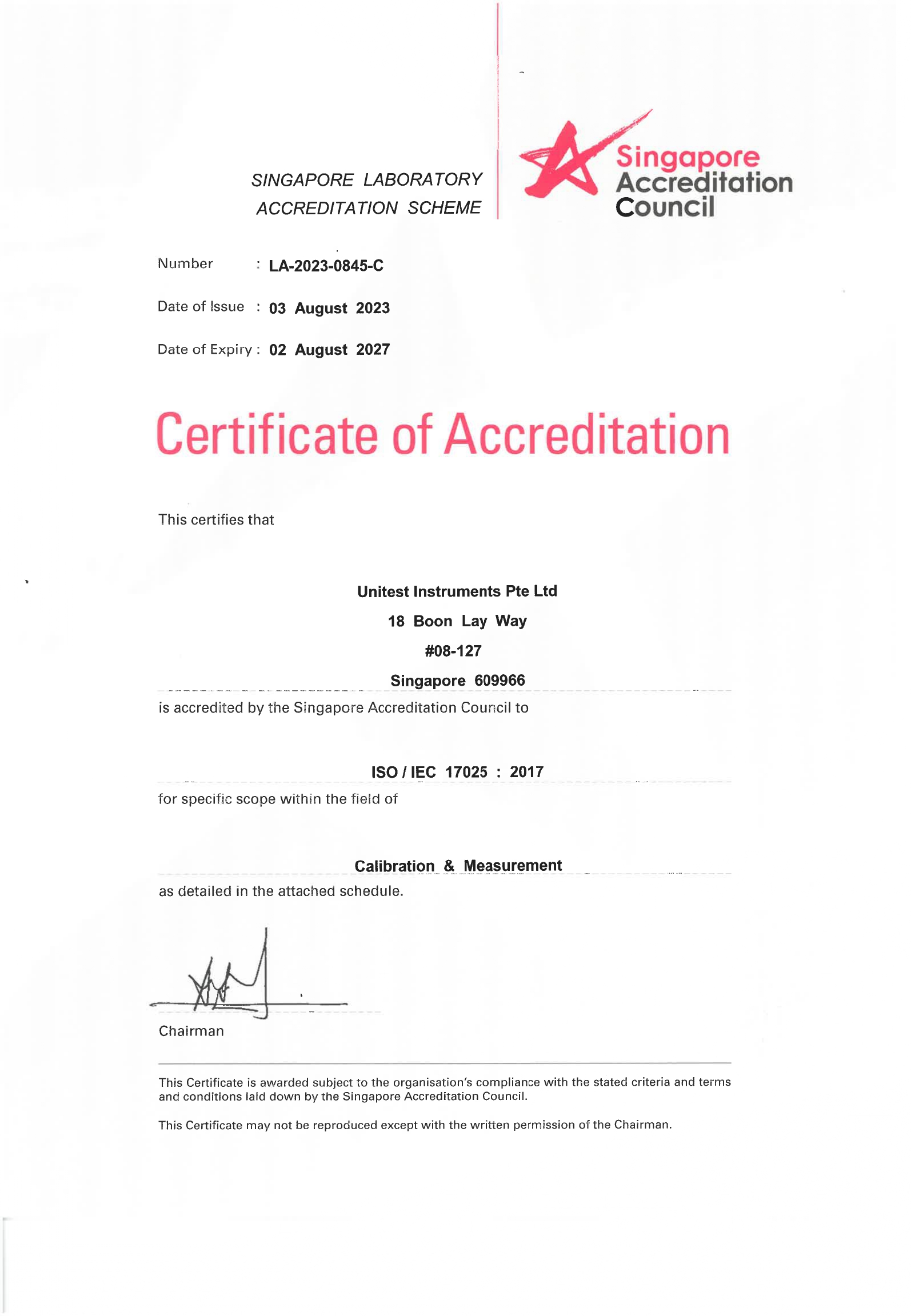
Calibration competence
SAC-SINGLAS · ISO/IEC 17025:2017
No. LA-2023-0845-C · valid to 2 Aug 2027
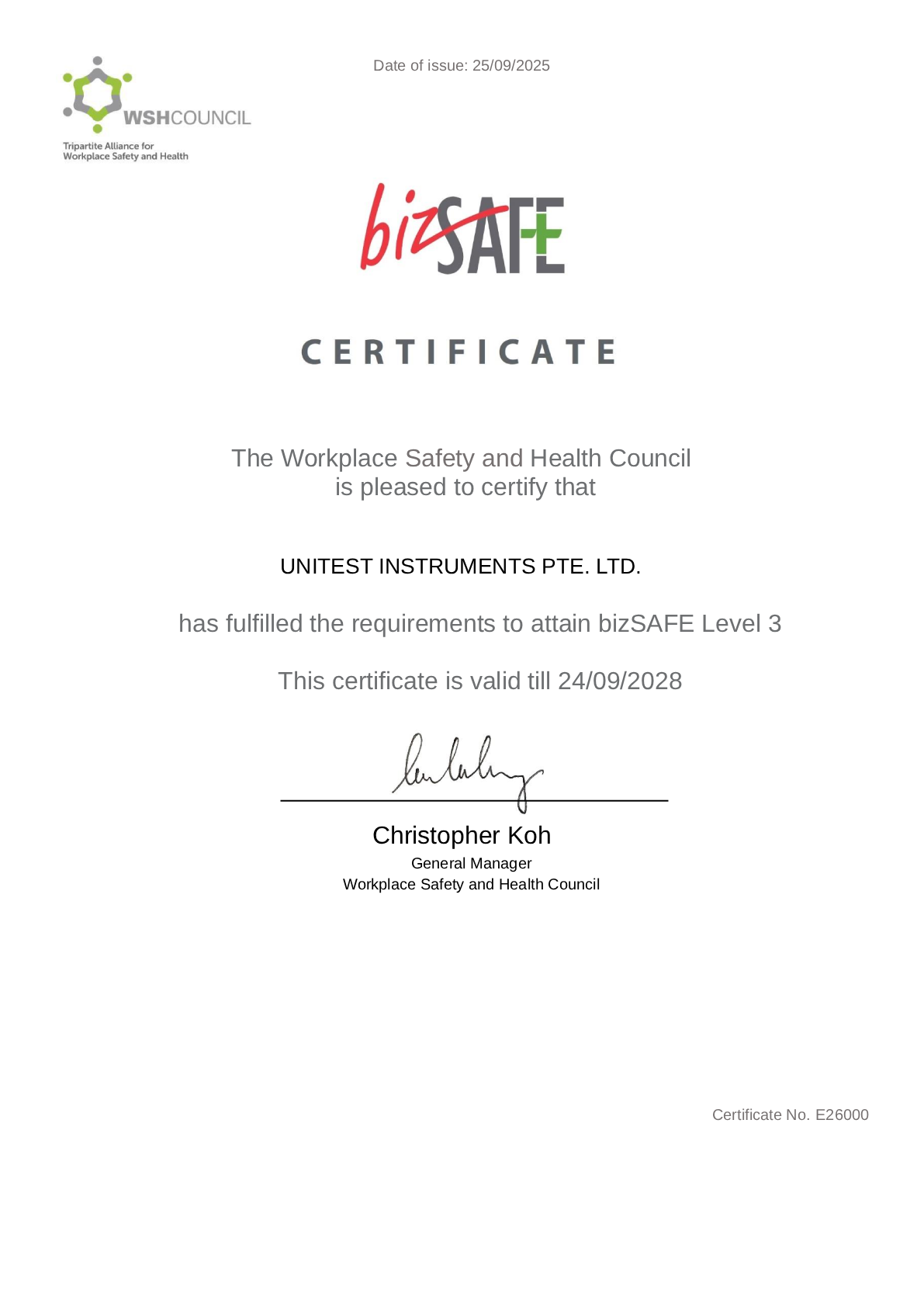
Workplace safety
bizSAFE Level 3
WSH Council · valid to 24 Sep 2028
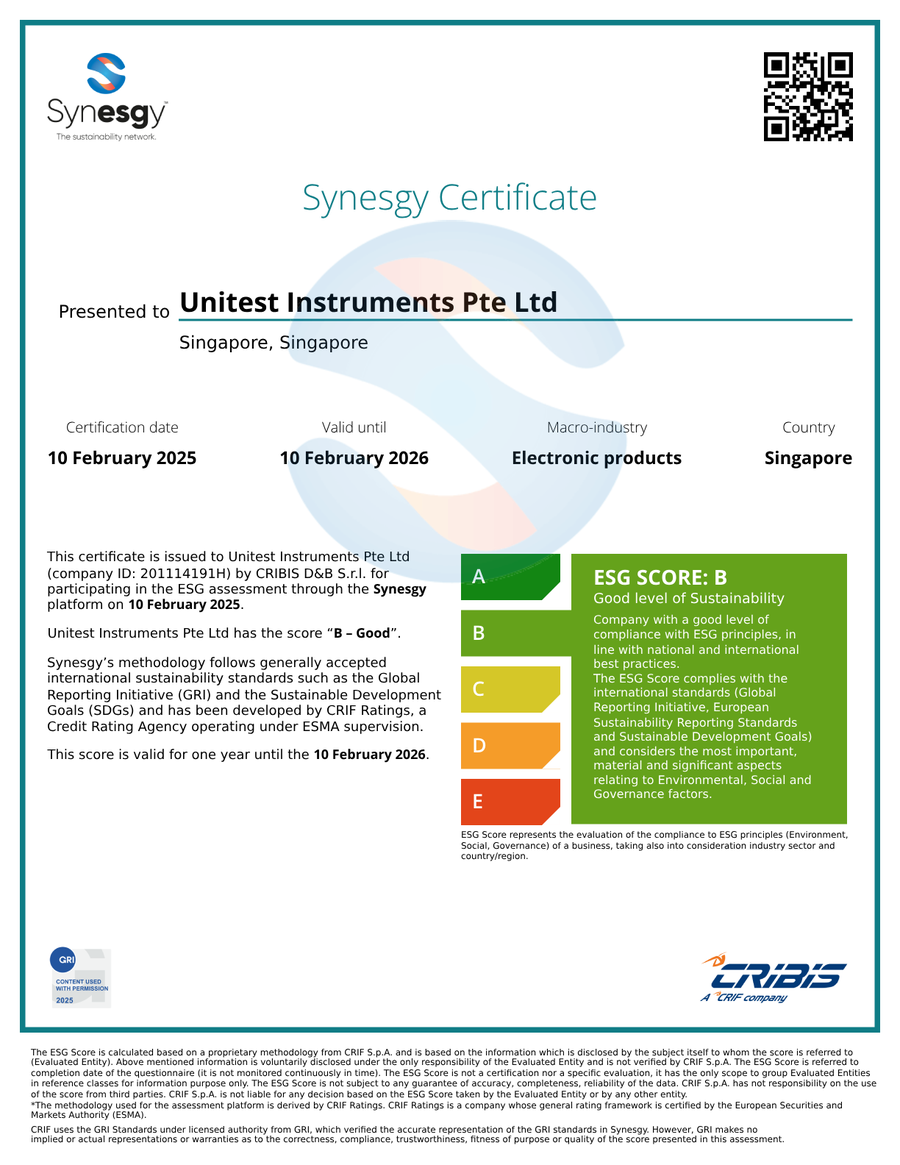
Sustainability (ESG)
Synesgy
ESG assessment · score B
Our commitment to precision — and to safety
At Unitest, accreditation isn't a badge on the wall — it's how we prove the number on every certificate can be trusted. Two independent standards govern how we work: ISO/IEC 17025:2017 for the quality of our measurements, and bizSAFE Level 3 for the safety of the people who make them.
Why ISO/IEC 17025:2017 matters
Our laboratory is accredited to ISO/IEC 17025:2017 and re-assessed by third-party auditors — so our competence is verified, not asserted. For you, that means:
- Service quality — every calibration held to a consistent, audited standard.
- Data precision — results whose accuracy and stated uncertainty you can rely on.
- Laboratory effectiveness — methods and competence kept at the level your auditors expect.
The result is peace of mind: certificates that hold up in an ISO 9001 / 17025 audit, every time.
Why bizSAFE Level 3 matters
We hold our workplace to that same discipline. Our bizSAFE Level 3 certification reflects:
- Management commitment — leadership accountable for a safe working environment.
- Continual improvement — safety practices implemented, documented and reviewed, not set-and-forgotten.
- Peace of mind — for your team and ours, on every on-site job.
Choose Unitest and you choose a partner committed to precision, reliability and safety — backed by accreditation, not adjectives. Certificate copies are available on request.
Scope of accreditation
What we are accredited for
Our full scope of accreditation (LA-2023-0845-C) covers electrical, temperature and pressure disciplines. The table below lists every accredited measured quantity and its calibrated range.
| Discipline | Measured Quantities / Instruments | Accredited Range |
|---|---|---|
| Electrical | Resistance Measuring Instruments | 0 Ω – 1200 MΩ |
| DC Voltage Measuring Instruments | 0 mV – 1020 V | |
| AC Voltage Measuring Instruments | 1 mV – 1020 V (3 Hz – 1 MHz) | |
| DC Current Measuring Instruments | 0 µA – 30 A | |
| DC Current Clamp Measuring Instruments | 0 mA – 1500 A | |
| AC Current Measuring Instruments | 20 µA – 30.2 A (10 Hz – 30 kHz) | |
| AC Current Clamp Measuring Instruments | 10 mA – 1500 A (30 Hz – 200 Hz) | |
| Frequency Measuring Instruments | 0.01 Hz – 2 MHz | |
| Capacitance Measuring Instruments | 0.2 nF – 120 mF | |
| Inductance Measuring Instruments | 13 µH – 120 H | |
| Resistance Sourcing Instruments | 0.01 Ω – 10 GΩ | |
| DC Voltage Sourcing Instruments | 0 mV – 1000 V | |
| AC Voltage Sourcing Instruments | 1 mV – 1000 V (3 Hz – 300 kHz) | |
| DC Current Sourcing Instruments | 0 µA – 30 A | |
| AC Current Sourcing Instruments | 10 µA – 30 A (3 Hz – 100 kHz) | |
| Frequency Sourcing Instruments | 1 Hz – 100 MHz | |
| Capacitance Sourcing Instruments | 0.1 nF – 100 mF | |
| DC Power Measuring Instruments | 0.02 W – 1500 kW | |
| AC Power Measuring Instruments | 0.02 W – 1500 kW | |
| Low Resistance (Earth Resistance) Measuring Instruments | 100 mΩ – 10 kΩ | |
| High Resistance (Insulation Resistance) Measuring Instruments | 10 kΩ – 999.9 GΩ | |
| Ground Bond Resistance Measuring Instruments | 30 mΩ – 1.7 kΩ | |
| Leakage Current Measuring Instruments | 0.1 mA – 30 mA | |
| Residual Current Measuring Instruments | Trip current: 3 mA – 3000 mA | |
| Oscilloscope (Vertical, Horizontal & Bandwidth) | 50 kHz – 1100 MHz | |
| Stop Watch / Timer | 1 s – 10800 s | |
| Resistance Measuring Instruments (Fixed Points) | 0 Ω – 100 MΩ | |
| Temperature | RTD / PRT Sensor with Indicator & Temperature Measuring Instruments | −80 °C – 660 °C |
| Thermocouple Wire with Indicator | −80 °C – 1000 °C | |
| Temperature Indicator with Other Sensors | −80 °C – 660 °C | |
| Fixed Point RTD Sensor | −196 °C, TPW (0.01 °C), Gallium (29.7647 °C), Aluminium (660.3226 °C) | |
| Thermistor | TPW & Gallium Fixed Points | |
| RTD / PRT Sensor without Indicator | −95 °C – 660 °C | |
| Thermocouple Wire without Indicator | −95 °C – 1000 °C | |
| Connecting Thermocouple Wire | Types S, R, J, K, N, T, E (0 °C – 30 °C) | |
| C/J Thermocouple Wire | Types S, R, J, K, N, T, E (0 °C – 30 °C) | |
| Thermocouple Indicator / Simulator (K, N, J, T, R, S, E) | −250 °C – 1770 °C (type-dependent) | |
| RTD & PRT Indicator / RTD Simulator — PT385 (100 Ω) | −200 °C – 800 °C | |
| Dry Block Calibrator | −95 °C – 600 °C | |
| Non-Contact Temperature (IR Thermometer / Thermal Imager) | 5 °C – 500 °C | |
| Humidity / Temperature Measuring Instruments | Temp: 5 °C – 50 °C · Humidity: 5 – 90 %RH | |
| Temperature Enclosure (Freezers, Ovens & Furnaces) | −80 °C – 1000 °C | |
| Liquid Bath | −80 °C – 270 °C | |
| Pressure | Pneumatic Pressure Instruments | −13 psi – 1000 psi |
| Hydraulic Pressure Instruments | 0 psi – 10000 psi |
All accredited parameters and instrument types can also be provided as traceable (non-accredited) calibration services where accreditation is not required, or where the instrument falls outside the accredited scope (different ranges, models, or site conditions). We additionally offer weighing scale calibration (up to 5 kg) as a traceable non-accredited service. Ask us — we'll confirm which applies to your instruments.
What you receive
A calibration certificate that passes any audit
Every instrument we calibrate leaves with a formal calibration certificate issued under Accreditation No. LA-2023-0845-C. It states the instrument details, calibration date, due date, standards used, calibration type, and — critically — measurement uncertainty at 95% confidence.
- Equipment details: manufacturer, model, serial number
- Standards used with their own traceable reference numbers
- Calibration type (As Found / After Adjustment)
- Expanded measurement uncertainty (k=2, ~95% confidence)
- Signed by Laboratory Engineer and Technical Manager
- Issued under ILAC-MRA mutual recognition
The certificate references the calibration procedure UNI-T001 and is issued in accordance with the SAC terms of accreditation. Calibration reports without an authorising signature are not valid.
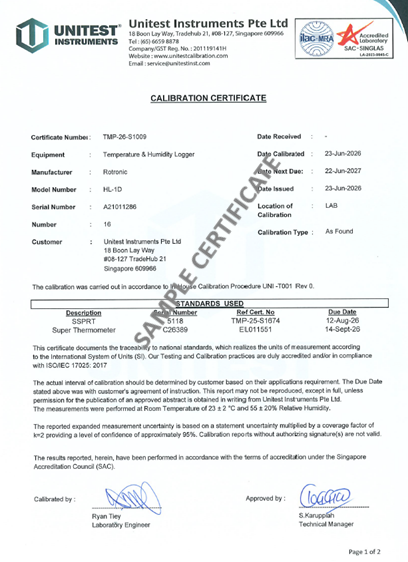
Sample certificate — click to view full size
Temperature & Humidity Logger · Page 1 of 2
Questions
Accreditation FAQ
Is Unitest a SAC-SINGLAS accredited lab?
Yes — Accreditation No. LA-2023-0845-C, to ISO/IEC 17025.
Will your certificate pass my ISO 9001 / 17025 audit?
Yes — our accredited certificates carry recognised measurement traceability, which is what auditors require.
What is the difference between accredited and non-accredited calibration?
Accredited calibration is independently assessed for competence and traceability; non-accredited work carries no such third-party assurance.
Do I need accredited calibration, or is traceable calibration enough?
It depends on your quality system and your auditor's requirements. Accredited calibration carries independently assessed methods and stated measurement uncertainty; traceable calibration uses the same reference standards without the third-party endorsement — often sufficient for non-critical instruments. Tell us how the instrument is used and we'll recommend the right option.
How do I get a copy of your scope of accreditation?
Request our current Scope of Accreditation via the contact form and we'll send the parameters and ranges that apply to your instruments.