
SAC-SINGLAS Accredited · ISO/IEC 17025
Oscilloscope Calibration
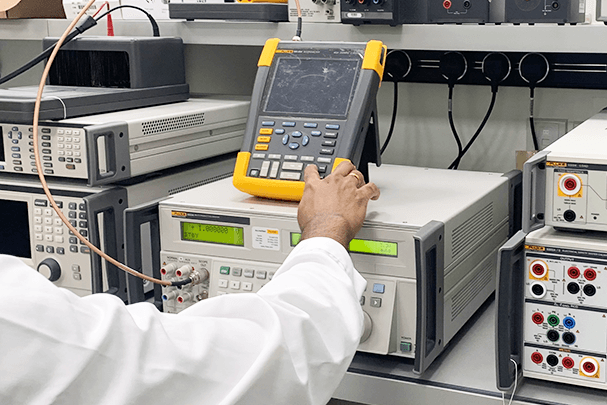
Unitest calibrates oscilloscopes in Singapore for bandwidth up to 1100 MHz (verifying bandwidth, timebase, amplitude and trigger accuracy against known reference standards), with traceable ISO/IEC 17025 certificates, in our lab or on-site.
What is Oscilloscope Calibration?
An oscilloscope is a vital tool used in electronics, telecommunications, and various scientific fields to visualize and analyze electrical waveforms. Calibration is the systematic process of verifying and adjusting the accuracy of an oscilloscope’s measurements against known reference standards. Over time, various factors can lead to measurement inaccuracies in an oscilloscope, such as aging components, environmental conditions, or rough handling during transportation. Calibration ensures that your oscilloscope’s measurements remain precise and reliable, providing trustworthy data for your applications.
When Should You Calibrate Your Oscilloscope?
The frequency of calibration depends on several factors, including the instrument’s age, usage, and environmental conditions. As a general guideline:
New Equipment: New oscilloscopes should undergo initial calibration to ensure accurate measurements from the start.
Regular Calibration: Periodic calibration is recommended, typically annually, especially if the oscilloscope is critical for high-precision applications or operates under challenging conditions.
After Repairs or Modifications: After any significant repairs or modifications, recalibration is essential to verify the oscilloscope’s performance.
Change in Operating Environment: Calibration may be necessary if the oscilloscope is moved to a different location or exposed to extreme environmental conditions.
Conclusion
In conclusion, oscilloscope calibration is a fundamental process for maintaining accurate measurements, ensuring reliability, and complying with industry standards. By performing regular calibrations, you can be confident in the precision of your oscilloscope and make informed decisions based on dependable data.
In the following sections of this guide, we will delve deeper into the calibration process, step-by-step procedures, necessary equipment, and best practices to empower you with the knowledge and skills to perform oscilloscope calibration effectively. Let’s embark on this journey to master the art of oscilloscope calibration!
What we calibrate
Oscilloscope instruments we calibrate
- Digital storage oscilloscopes
- Analogue oscilloscopes
- Mixed-signal oscilloscopes
- Oscilloscope probes
Accredited under SAC-SINGLAS LA-2023-0845-C. View our accreditation & scope →
Instrument guides: Digital Storage Oscilloscope
Questions
Oscilloscope calibration FAQ
Why is Oscilloscope Calibration Important ?
Calibrating your oscilloscope is crucial for several key reasons: Accuracy and Reliability: Calibration ensures that the measurements displayed on the oscilloscope screen are as close to the true values as possible. Accurate measurements are vital for diagnosing problems, designing circuits, and verifying the performance of electronic devices. Consistency: Calibration ensures consistency across measurements, regardless of the operator or time of measurement. It allows multiple users to obtain comparable results, improving collaboration and reducing uncertainties. Compliance: In many industries, regulatory bodies may mandate regular calibration to comply with quality standards and maintain certification for various electronic systems. Cost-Effectiveness: By detecting and correcting measurement inaccuracies early on, calibration helps avoid costly errors, rework, or product recalls. Customer Trust: For businesses and manufacturers, calibration builds customer trust in the reliability of their products and services.
Range information
Up to 1100 MHz
Accredited ranges
Oscilloscope calibration ranges & measurement uncertainty
The parameters, ranges and calibration & measurement capability (CMC) below are taken from our SAC-SINGLAS Schedule of Accreditation (LA-2023-0845-C, to ISO/IEC 17025). CMC is the smallest measurement uncertainty we can achieve under accredited conditions.
Oscilloscope Calibration – Vertical Deflection @ DC Signal (50 Ω Input)· UNI-E005 Rev:0
| Range / measured quantity | Measurement uncertainty (CMC) |
|---|---|
| ± 1 mV – ± 24.999 mV | 2 % |
| ± 25 mV – ± 109.99 mV | 0.6 % |
| ± 110 mV – ± 2.1999 V | 6.4 % |
| ± 2.2 V – ± 6.6 V | 0.5 % |
Oscilloscope Calibration – Vertical Deflection @ DC Signal (1 MΩ Input)· UNI-E005 Rev:0
| Range / measured quantity | Measurement uncertainty (CMC) |
|---|---|
| ± 1 mV – ± 24.999 mV | 3.8 % |
| ± 25 mV – ± 109.99 mV | 0.49 % |
| ± 110 mV – ± 2.1999 V | 0.47% |
| ± 2.2 – ± 10.999 V | 0.46 % |
| ± 11 V – ± 130 V | 0.46 % |
Oscilloscope Calibration – Vertical Deflection @ AC Signal (50 Ω Input)· UNI-E005 Rev:0
| Range / measured quantity | Measurement uncertainty (CMC) |
|---|---|
| 1 mVp-p to ± 24.999 mVp-p | 1.9 % |
| 25 mV p-p – ±109.99mVp-p | 0.6 % |
| 110 mVp-p – ± 2.1999 Vp-p | 5.3 % |
| 2.2 Vp-p – ± 6.6 Vp-p | 0.5 % |
Oscilloscope Calibration – Vertical Deflection @ AC Signal (1 MΩ Input)· UNI-E005 Rev:0
| Range / measured quantity | Measurement uncertainty (CMC) |
|---|---|
| ± 1 mVp-p – ± 24.999 mVp-p | 3.2 % |
| ± 25 mV – ± 109.99 mVp-p | 0.51 % |
| ± 110 mVp-p – ± 2.1999 Vp-p | 0.48% |
| ± 2.2 Vp-p – ± 10.999 Vp-p | 0.47 % |
| ± 11 Vp-p – ± 130 Vp-p | 0.47 % |
Oscilloscope Calibration – Horizontal Deflection· UNI-E005 Rev:0
| Range / measured quantity | Measurement uncertainty (CMC) |
|---|---|
| 2 ns – 5 ns | 0.063 % |
| >5 ns – 10 ns | 0.081 % |
| >10 ns – 20 ns | 0.073 % |
| >20 ns – 50 ns | 0.061 % |
| >50 ns – 50 µs | 0.095 % |
| >50 µs – 20 ms | 0.073 % |
| >20 ms – 50 ms | 0.061 % |
| >50 ms – 5 s | 0.14% |
Oscilloscope Calibration – Bandwidth· UNI-E005 Rev:0
| Range / measured quantity | Measurement uncertainty (CMC) |
|---|---|
| 50 kHz – 100 MHz | 0.26 dB |
| >100 MHz – 300 MHz | 0.30 dB |
| >300 MHz – 600 MHz | 0.48 dB |
| >600 MHz – 1100 MHz | 0.57 dB |
Related
Other calibration disciplines
Electrical Calibration
Learn more →Timer & Stopwatch Calibration
Learn more →Guides & resources
Oscilloscope calibration guides
How Often Should You Calibrate Your Instruments? A Singapore Calibration-Interval Guide
How often should you calibrate measuring instruments in Singapore? A practical guide to calibration intervals by instrument type, usage and risk. Plus how to set your own schedule.
Read guide →Oscilloscope Calibration and Your ISO/IEC 17025 Audit: What Auditors Check
What does an ISO/IEC 17025 auditor look for on oscilloscope calibration certificates and records? A compliance guide for Singapore quality and test engineering teams.
Read guide →On-Site vs In-Lab Oscilloscope Calibration: Which Makes Sense for Your Scope?
Should you calibrate your oscilloscope on-site or send it to the lab? A practical comparison for Singapore facilities based on how the scope is used and deployed.
Read guide →How Often Should You Calibrate an Oscilloscope in Singapore?
How often should oscilloscopes be calibrated? A practical guide to setting a calibration interval for scopes in Singapore based on use, criticality and drift history.
Read guide →