
SAC-SINGLAS Accredited · ISO/IEC 17025
Humidity Calibration
Unitest provides humidity calibration in Singapore over a range of 5% to 90% relative humidity (at temperatures of 5°C to 50°C) (for hygrometers, humidity/temperature probes and data loggers, transmitters and climatic chambers), with traceable ISO/IEC 17025 certificates.
When are Humidity Calibration Services essential in Singapore?
Humidity plays a significant role in influencing the characteristics of air and the materials it comes into contact with. It’s essential to monitor and measure humidity, especially in places where you want to prevent issues such as condensation, corrosion, mold, warping, or spoilage of products.
Humidity calibration should be carried out under the following circumstances:
Initial Setup: New humidity measuring instruments should undergo calibration to establish their accuracy.
Regular Calibration: Periodic calibration is recommended, typically annually or based on manufacturer recommendations and industry standards.
After Repairs or Modifications: Calibration should be performed after significant repairs or modifications to verify the instrument’s accuracy.
Critical Applications: For applications where humidity measurements are vital for safety, quality, or compliance, more frequent calibration may be necessary.
Conclusion
In conclusion, opting for humidity calibration services in Singapore is crucial for obtaining accurate and reliable humidity measurements in various applications. Whether you are working in an industrial setting, conducting environmental research, or ensuring proper storage conditions for valuable items, calibrated humidity measuring instruments are essential for obtaining dependable data. By understanding humidity calibration and following the appropriate calibration procedures, you can ensure the accuracy and precision of your humidity measurements.
In the following sections of this guide, we will delve deeper into the humidity calibration process, explore calibration techniques, necessary equipment, and best practices. Let’s embark on this journey to master the art of humidity calibration and elevate the quality of your humidity measurements!
What we calibrate
Humidity instruments we calibrate
- Hygrometers
- Humidity / temperature probes
- RH/T data loggers
- Humidity transmitters
- Climatic / stability chambers
Accredited under SAC-SINGLAS LA-2023-0845-C. View our accreditation & scope →
Instrument guides: Hygrometer / RH Meter · Humidity / RH Transmitter · Thermo-Hygrometer · Dew Point Meter
Questions
Humidity calibration FAQ
Why is Humidity Calibration Important ?
Accurate humidity measurements are essential for a wide range of applications: Industrial Processes: Humidity control is crucial in industrial processes like pharmaceutical manufacturing, food processing, electronics production, and HVAC systems to ensure product quality and safety. Agriculture: Humidity affects plant growth, storage conditions, and crop quality, making precise humidity measurements vital for agriculture. Environmental Monitoring: Humidity influences weather patterns, climate studies, and ecological research, making accurate humidity data crucial for understanding environmental changes. Museums and Archives: Maintaining proper humidity levels is critical for preserving artworks, historical artifacts, and valuable documents. Humidity calibration is important for the following reasons: Data Accuracy: Calibration ensures that humidity measurements are accurate and reliable, providing dependable data for critical decision-making. Process Control: In industrial settings, precise humidity control is necessary for maintaining product quality and optimizing manufacturing processes. Regulatory Compliance: Certain industries and applications may require calibrated humidity instruments to comply with industry standards and regulations. Equipment Verification: Calibration verifies the performance and accuracy of humidity sensors, allowing for timely maintenance and replacements when necessary.
How often should we calibrate humidity?
Unitest Calibration features temperature sensor and humidity sensor calibration in Singapore. We recommend that you check your device or probe regularly. Calibration once a year is usually sufficient. It is good to calibrate the probe more frequently. Still, as a rule of thumb, calibration intervals can vary from once a year to calibrating before each measurement, depending on the company’s internal quality assurance regulations.
How is Humidity Calibration carried out?
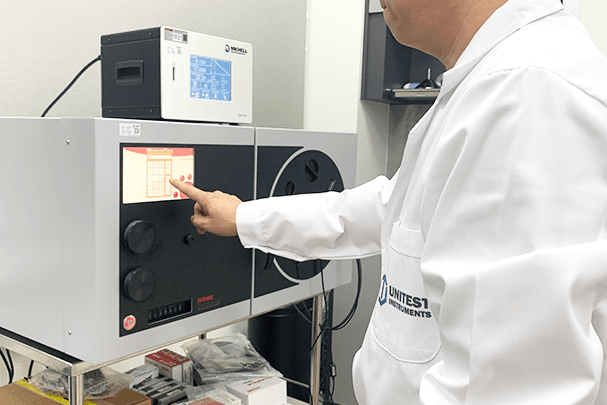
Humidity calibration stabilises the humidity of the sample gas and measures it against a suitable base reference. A humidity calibration system consists of • Dry air source, • A moisture generator that provides the required moisture content, • A reference instrument that is more accurate than the device under test to provide reliable measurements • A manifold that supplies calibration gas to the sensor/instrument under test. When calibrating for relative humidity and temperature, the manifold should be temperature controlled or placed in a temperature-controlled environment to determine the relative humidity dew point value with temperature.
Accredited ranges
Humidity calibration ranges & measurement uncertainty
The parameters, ranges and calibration & measurement capability (CMC) below are taken from our SAC-SINGLAS Schedule of Accreditation (LA-2023-0845-C, to ISO/IEC 17025). CMC is the smallest measurement uncertainty we can achieve under accredited conditions.
Humidity / Temperature measuring instruments (Lab / Site, Used Reference Probe)· UNI-T009 Rev:0
| Range / measured quantity | Measurement uncertainty (CMC) |
|---|---|
| Temperature: 5 °C – 50 °C | 0.3 °C |
| Humidity: (5 – 90) % relative humidity | 2.4 % relative humidity |
Humidity / Temperature measuring instruments (Lab, Used Chilled Mirror)· UNI-T009 Rev:0
| Range / measured quantity | Measurement uncertainty (CMC) |
|---|---|
| Temperature 15 °C – 50 °C | 0.2 °C |
| Humidity (40 – 90) % relative humidity | 1.2 % relative humidity |
| Fixed Temperature @23°C (05 – 50) % relative humidity | 0.7 % relative humidity |
| Fixed Temperature @23°C (50 – 90) % relative humidity | 1.1 % relative humidity |
Related
Other calibration disciplines
Temperature Calibration
Learn more →Chamber & Freezer Calibration
Learn more →Guides & resources
Humidity calibration guides
Semiconductor and Cleanroom Instrument Calibration in Singapore
Calibration for semiconductor fabs and cleanroom facilities in Singapore: which instrument types need it, why cleanroom-grade discipline matters, and how it connects to mapping.
Read guide →Cold-Chain and Reefer Transport Temperature Mapping in Singapore
Cold-chain and reefer transport temperature mapping in Singapore: how transport qualification differs from warehouse mapping, and what 3PLs need for HSA GDP compliance.
Read guide →Humidity Calibration in Singapore: The Complete Guide
Humidity calibration in Singapore explained: why RH probes drift, how calibration works, cost factors, calibration intervals, and what an accredited SAC-SINGLAS certificate shows.
Read guide →Temperature Mapping Sensor Placement: How Many Sensors Do You Need?
How many sensors do you need for temperature mapping? A practical Singapore guide to logger counts by space size, three-dimensional grids, and the worst-case points that must always be covered.
Read guide →