
Calibration Resources
Infrared and Radiation Thermometer Calibration: Emissivity, Blackbody and Accuracy
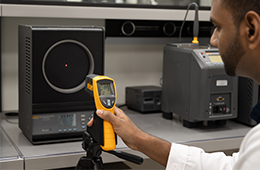
Infrared and radiation thermometers are calibrated by pointing them at a traceable blackbody source held at known temperatures across their range and recording the error at each point, and the calibration must account for emissivity, distance-to-spot ratio and spectral band, because a non-contact reading is only as good as those three factors; non-contact absolutely does not mean no-calibration. That last point is where a lot of money quietly leaks away. Because an infrared thermometer gives an instant number without touching anything, it is easy to assume it is always right. It is not. An uncalibrated or wrongly-set IR reading can be several degrees out while looking completely plausible, and false confidence in a non-contact number is exactly the kind of thing that traces back to a failed batch or a missed process fault. Here is how these instruments are calibrated, and why emissivity and blackbody traceability sit at the heart of it.
How a non-contact thermometer measures temperature
Every object above absolute zero emits thermal radiation, and the hotter it is, the more it emits. An infrared or radiation thermometer collects that radiation through its optics, focuses it onto a detector, and converts the signal into a temperature. There is no physical contact and no waiting for a probe to reach equilibrium, which is why non-contact measurement is invaluable for moving, live, hot or inaccessible targets. But that convenience rests on an assumption about how efficiently the target radiates, and that assumption is where the errors live.
Emissivity: the setting that makes or breaks the reading
Emissivity describes how efficiently a surface emits thermal radiation compared with a perfect emitter (a "blackbody", emissivity 1.00). A matte black surface radiates efficiently, close to 1.00; a shiny polished metal radiates poorly, with a low emissivity, and also reflects radiation from its surroundings into the instrument. An infrared thermometer has to be told, through its emissivity setting, what kind of surface it is looking at. Set it wrong and the reading is wrong: aim an instrument set for a matte surface at bright steel and it can read dramatically low, because the shiny metal is not emitting the radiation the instrument expects.
This is why emissivity is central to both using and calibrating a non-contact thermometer. Unitest calibrates infrared and radiation thermometers at emissivity values of 0.90 to 1.00, the high-emissivity range that matches blackbody-referenced calibration, under SAC-SINGLAS accreditation UNI-T008 (accreditation number LA-2023-0845-C). Understanding your own target's emissivity, and knowing that your instrument was calibrated against a known emissivity, is what turns a plausible number into a trustworthy one.
Distance-to-spot: are you measuring what you think you are?
The second trap is the distance-to-spot ratio. An infrared thermometer does not measure a pinpoint; it averages the temperature over a circular spot whose size grows as you move further from the target. If that spot is larger than the object you are aiming at, the instrument is also reading the background around it, and the result is a blend, not the target temperature. A reading of a small, hot component taken from too far away can be pulled toward the cooler surroundings and look reassuringly normal while the component itself is overheating. Knowing your instrument's distance-to-spot ratio, and standing close enough that the spot sits entirely within the target, is essential to a valid measurement, and it is part of using a calibrated instrument correctly.
Blackbody sources and the traceability chain
A non-contact thermometer cannot be calibrated by dunking it in a bath. Instead, it is calibrated against a blackbody source: a cavity or plate engineered to emit thermal radiation at a known temperature with a known, high emissivity close to 1.00. The blackbody is held at a series of set temperatures across the instrument's range, the thermometer under test is aimed at it under controlled conditions, and its reading is compared with the blackbody's traceable temperature. The blackbody's own temperature is established with traceable contact sensors, so the whole measurement chain links back to national standards and ultimately to ITS-90, just as a contact calibration does, but through radiation rather than immersion.
Unitest calibrates infrared and radiation thermometers against traceable blackbody sources across 35 to 500 degrees Celsius, at a spectral band of 8 to 14 micrometres and emissivity 0.90 to 1.00, with best measurement uncertainties in the region of 1.1 to 3.7 degrees Celsius across the scope. Those figures are the accredited reality of UNI-T008, and they are what the infrared thermometer calibration and radiation thermometer calibration services deliver.
Spectral band: why the wavelength matters
Infrared detectors respond to a particular band of wavelengths, and that band affects the measurement. Many general-purpose and facilities-grade instruments work in the 8 to 14 micrometre long-wave band, which suits near-ambient and moderate temperatures and is relatively forgiving of atmospheric effects. High-temperature process pyrometers often use shorter wavelengths better suited to glowing-hot targets. A calibration is meaningful when it is performed in a spectral band representative of how the instrument is used, which is why Unitest states the 8 to 14 micrometre band explicitly in its accredited scope. Matching the calibration conditions to the real application is part of what makes the certificate useful rather than nominal.
Infrared thermometer versus radiation thermometer
The two terms overlap, and metrologically they measure the same way, but they tend to describe different instruments and applications. "Infrared thermometer" usually means the handheld guns used for facilities, food, HVAC and general spot checks. "Radiation thermometer" (and its cousin the pyrometer) more often describes industrial and process instruments, including fixed units watching high-temperature processes, where formal radiation thermometry and emissivity control are taken very seriously. Unitest calibrates both under the same accredited UNI-T008 block, and maintains separate service pages so each application finds the right entry point: the infrared thermometer route for handheld and facilities use, and the radiation thermometer route for industrial and process thermometry. For the wider picture of how non-contact sits alongside contact sensors, see our temperature sensor types guide.
The false-confidence problem, and what it costs
The real risk with non-contact thermometry is not that people know it is uncertain; it is that they forget it can be. A contact probe that fails often fails obviously. An infrared gun that is reading three degrees high because its optics are dirty, its emissivity setting is wrong, or it has drifted since it was last checked, gives a clean, confident, wrong number that nobody questions. In a semiconductor or electronics process, a food-safety check, or a preventive-maintenance thermography round, that false confidence is expensive: a hot spot dismissed as fine, a cold product passed as safe, an overheating connection logged as normal. Calibration against a traceable blackbody is what replaces that false confidence with a known, stated uncertainty. It tells you not just what the instrument reads, but how much you can trust the reading.
Who relies on calibrated non-contact thermometers in Singapore
Non-contact instruments are everywhere in Singapore industry, and the ones that matter are the ones tied to a decision:
- Semiconductor and electronics manufacturing: process and equipment temperature checks where a wrong reading feeds yield loss.
- Food and beverage operations: surface checks in cold-chain and processing tied to HACCP and SFA expectations.
- Facilities and predictive maintenance: thermography of switchboards, motors and bearings where a missed hot spot risks failure or fire.
- Pharmaceutical and laboratory settings: surface and equipment checks that support a controlled environment.
For all of them, an uncalibrated non-contact reading is a decision made on an unverified number. Calibration turns it into a decision made on evidence.
Getting a trustworthy reading between calibrations
Calibration establishes what an instrument does under controlled conditions, but a non-contact thermometer still has to be used correctly in the field to keep that accuracy meaningful. A few habits protect the reading between calibrations:
- Set the emissivity for the actual target, not a factory default. A shiny surface may need a matte tag or a known high-emissivity spot to read reliably.
- Stand close enough that the spot fits the target, respecting the instrument's distance-to-spot ratio so the background is not blended in.
- Keep the optics clean, because dust, condensation or a smeared lens attenuates the signal and biases the reading, and in Singapore's humidity a cold lens brought into warm air can fog.
- Let the instrument acclimatise to the ambient temperature before use, since a large temperature difference between the gun and its surroundings can affect the electronics.
- Watch for reflected radiation from nearby hot sources, which a low-emissivity target can reflect into the detector and inflate the reading.
These are the operator-side companions to a good calibration. The calibration proves the instrument is capable; correct technique ensures the capability is realised on the shop floor.
Calibrate your non-contact thermometers, not just your probes
If your team leans on infrared guns or radiation thermometers for any decision that matters, they need the same calibration discipline as your contact probes, referenced to a traceable blackbody with a stated emissivity and uncertainty. Send us your non-contact thermometer list and the temperature ranges you use, and we will confirm what is covered under our SAC-SINGLAS scope (UNI-T008) and return a clear quote, with no obligation. Get started on the contact page.
Frequently asked questions
How is an infrared or radiation thermometer calibrated?
It is calibrated against a traceable blackbody source: a cavity or plate that emits thermal radiation at a known temperature with a known high emissivity. The blackbody is held at a series of set temperatures across the instrument's range, the thermometer under test is aimed at it under controlled conditions, and its reading is compared with the blackbody's traceable temperature. The chain links back to national standards through the calibrated contact sensors that establish the blackbody temperature.
Why does emissivity matter for non-contact temperature measurement?
Emissivity describes how efficiently a surface emits thermal radiation compared with a perfect emitter. A matte surface radiates efficiently while shiny metal radiates poorly and reflects surroundings, so the instrument must be told the target's emissivity. Set it wrong and the reading can be several degrees out while looking plausible. Unitest calibrates infrared and radiation thermometers at emissivity 0.90 to 1.00 under accredited scope UNI-T008, so the reference emissivity is known.
What temperature range and uncertainty does Unitest cover for infrared calibration?
Under SAC-SINGLAS accreditation UNI-T008, Unitest calibrates infrared and radiation thermometers across 35 to 500 degrees Celsius, at a spectral band of 8 to 14 micrometres and emissivity 0.90 to 1.00, against traceable blackbody sources. Best measurement uncertainties are in the region of 1.1 to 3.7 degrees Celsius across the scope, with the exact figure stated for each calibration point on the certificate.
Does a non-contact thermometer really need calibration?
Yes. Non-contact does not mean no-calibration. An infrared thermometer that has drifted, has dirty optics, or is set to the wrong emissivity gives a clean, confident, wrong number that nobody questions, which is more dangerous than an obviously broken probe. Calibration against a traceable blackbody replaces that false confidence with a known, stated uncertainty so you can trust the reading behind a real decision.
What is the difference between an infrared thermometer and a radiation thermometer?
Metrologically they measure the same way, by collecting emitted thermal radiation, but the terms describe different instruments. Infrared thermometer usually means the handheld guns used for facilities, food and HVAC spot checks, while radiation thermometer and pyrometer more often describe industrial and process instruments where formal emissivity control matters. Unitest calibrates both under the same accredited UNI-T008 scope through separate service pages.
What is distance-to-spot ratio and why does it matter?
The distance-to-spot ratio describes how the measured spot grows as you move away from the target, because an infrared thermometer averages temperature over a circular area rather than a pinpoint. If the spot is larger than the object, the instrument also reads the cooler or warmer background and blends it in, giving a misleading result. Standing close enough that the spot sits entirely within the target is essential to a valid non-contact measurement.
Related services